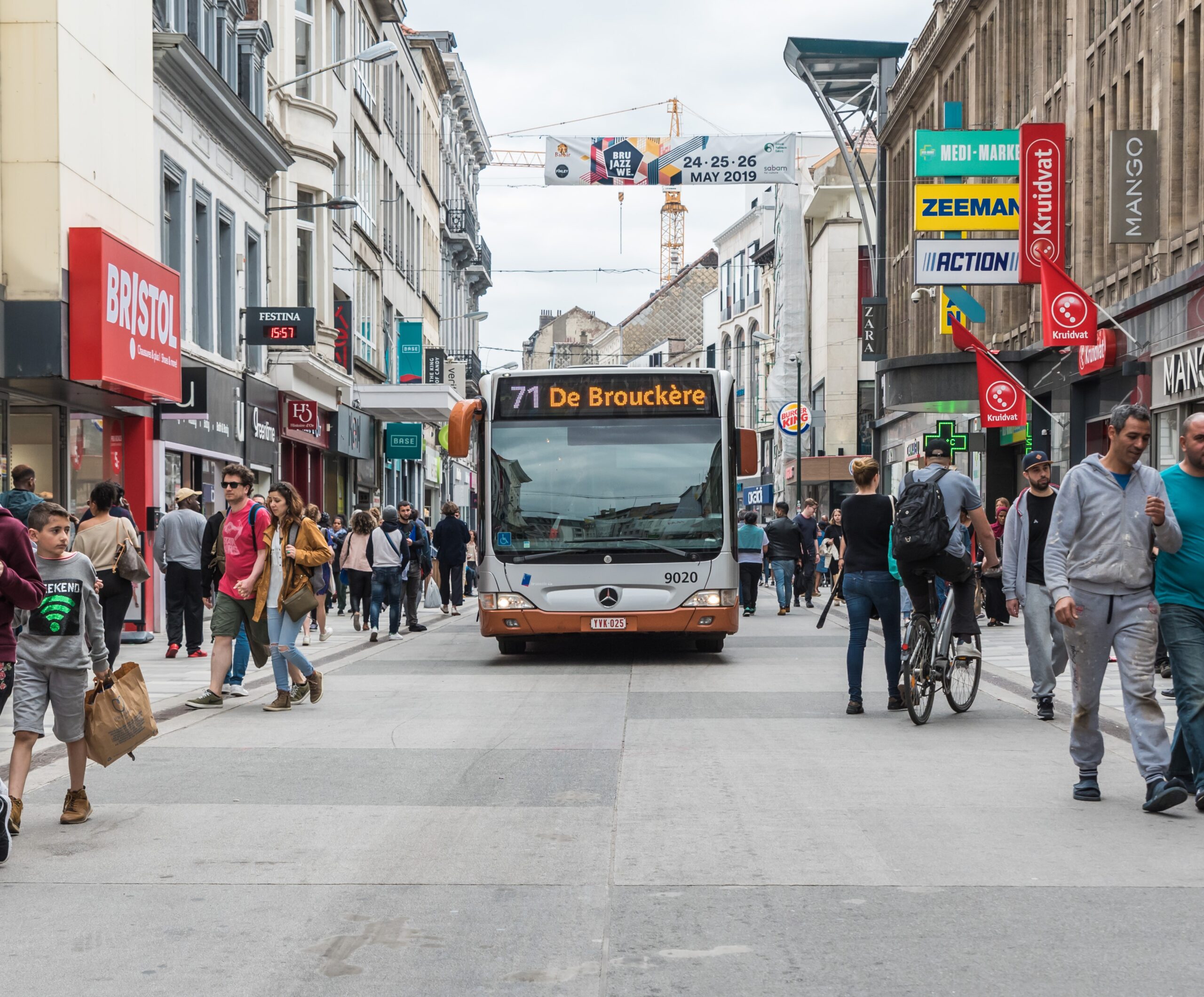
The result of a partnership between hub.brussels, perspective.brussels and the Université Libre de Bruxelles, this study, carried out in 2018, aims to assess the effectiveness of commercial-centre zones by analysing changes in the number of shops and the recorded retail floor area within the Region between 1997 and 2017.
A framework to preserve the traditional retail landscape
In the preparatory work leading up to the introduction of the PRAS, the public authorities decided it was necessary to strengthen the main commercial centres while limiting the spread of new commercial developments across the Region. The aim was to tackle the decline in the number of shops that had been observed over several decades.
With this in mind, nearly 200 commercial centres were identified across the Region and formed the basis on which the regulatory framework was to be developed. In the final version of the PRAS, the smallest commercial centres and sections of street were excluded in order to prioritise the development of projects in the Region’s most strategic areas. This gave rise to the strips for commercial centres, a legal framework designed to preserve 109 centres, representing approximately 48% of the retail landscape at the time.
To support this planning layer, urban planning guidelines were drawn up. They promote retail in the strips whilst imposing stricter controls on its development elsewhere by setting thresholds, with varying degrees of restrictions, for the volume floor area authorised across the territory.
However, from the outset, the system had certain limitations, notably the fact that it was based on a situation observed at a specific point in time. However, by its very nature, retail activity is constantly evolving, and protected areas may, in the long term, no longer correspond to the areas that are actually attractive for retail (or vice versa).
Objectives only partially met
The study shows that, over a 20-year period, the number of retail outlets in Brussels fell by more than 8%. Overall, this decline had little impact on the areas protected by the PRAS, where the reduction was less than 1%. But this relative stability hides very contrasting realities, with some strips experiencing strong growth, whilst others lost more than a quarter of their shops.
It is therefore difficult to attribute the continued existence of these areas solely to the introduction of the strips, particularly as retail activity naturally tends to cluster in the most attractive, most accessible and busiest locations. This trend towards concentration would probably have produced some of the results seen anyway, even without the specific regulations.
At the same time, despite the decline in the number of retail outlets, the spatial footprint of the retail sector continued to grow between 1997 and 2017, and the total surface area of plots occupied by retail activity rose by around 63 hectares over the 20-year period. This growth can be explained by changes in the retail sector in terms of format, location and network organisation – changes which exceeded the scope envisaged when the PRAS was established. This led to the establishment of new developments in highly mixed areas, administrative areas, urban enterprise zones and industrial zones. These areas, which offer more space, better accessibility and affordable plots, compete with the traditional commercial centres that the PRAS was specifically seeking to preserve, thereby undermining its original retail objective.